
Engineering that turns an alert into a fix that holds.
Our engineers find the fault using the data, then work back to the cause, reading the machine against the history in your existing systems and the live data collected. Whether that’s a cause and a method your own fitters can follow, or our engineers on site. Your team keeps the plant running while we deliver the remediation projects.
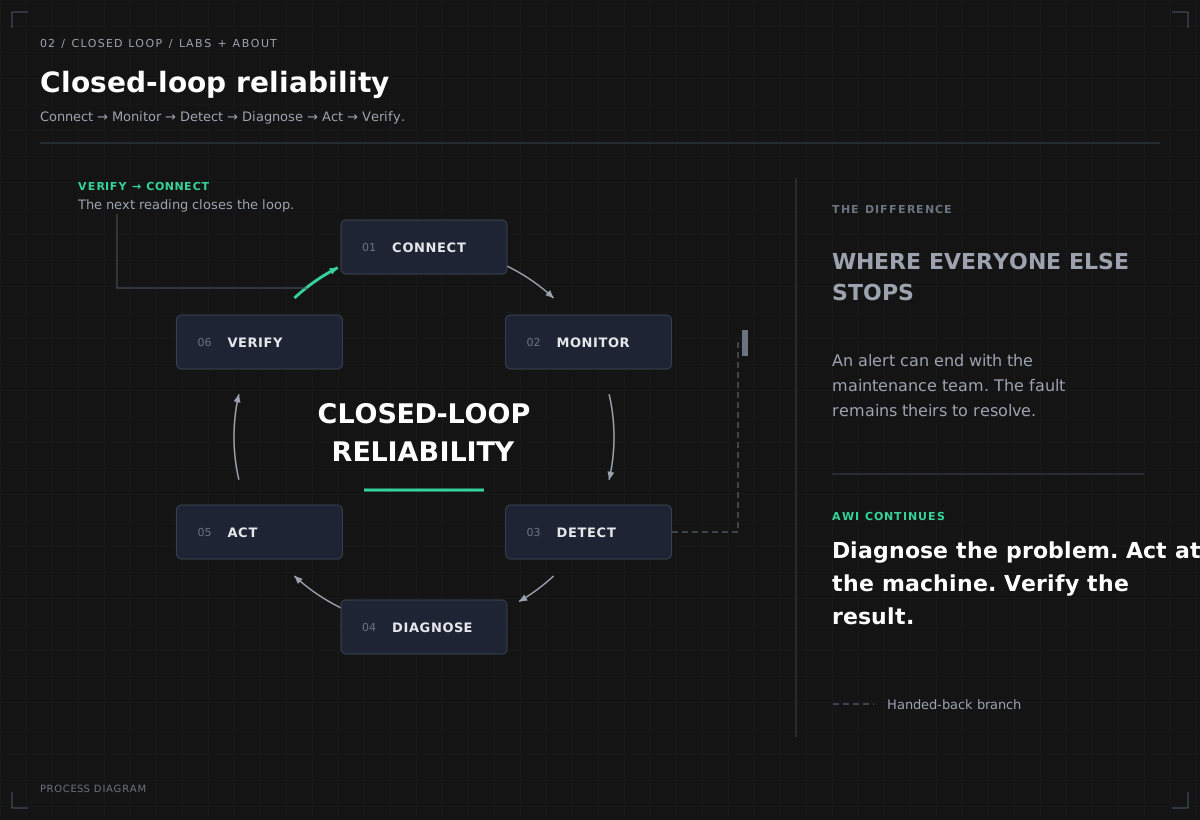
Six steps to closed-loop reliability.
Everyone else stops at the alert. The loop only closes when someone connects the sensors, stands at the machine, does the work, and measures again afterwards. That is what AWI Labs is for.
Condition monitoring and fault diagnosis starting with critical assets.
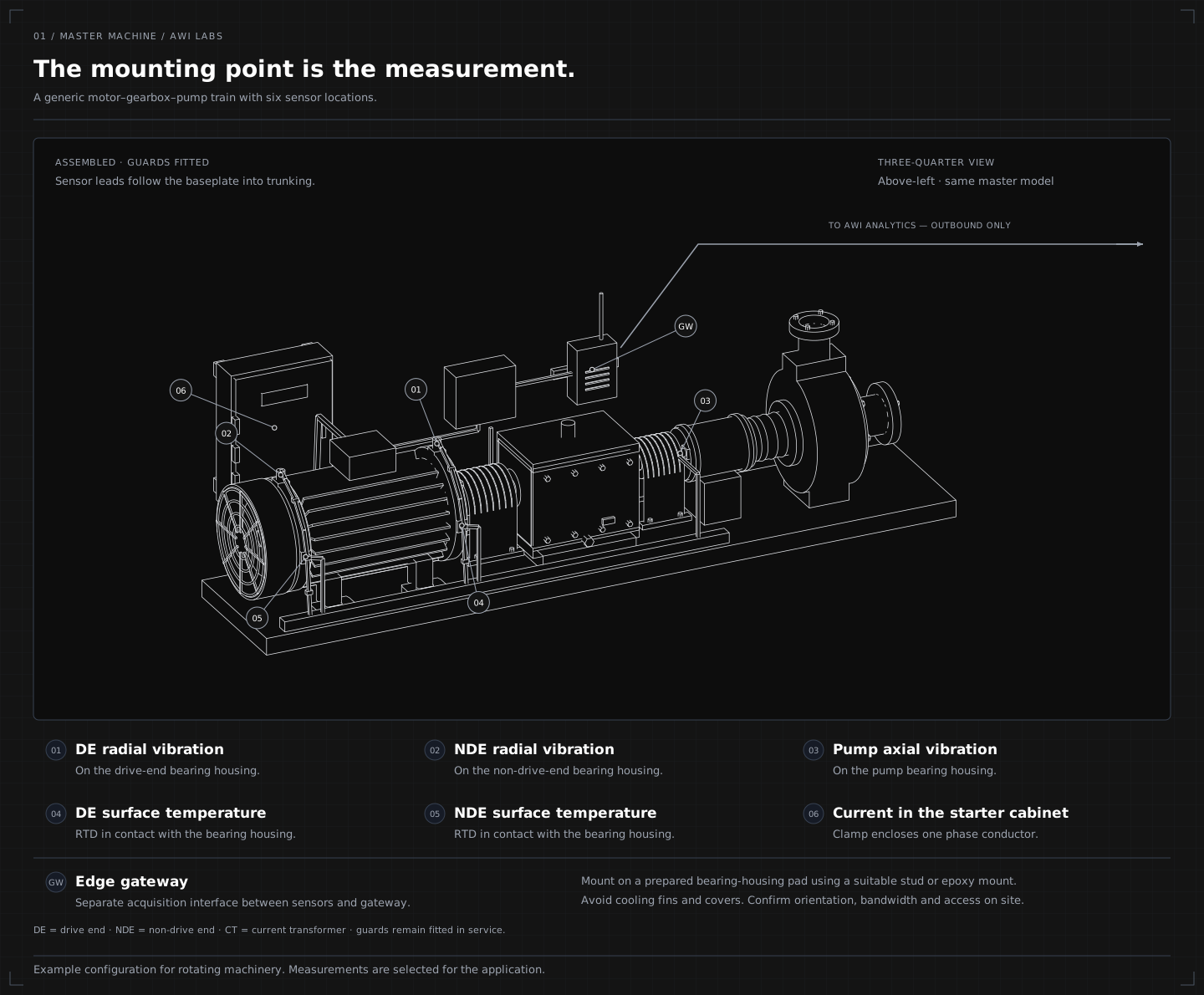
Condition monitoring is measurements taken on a running machine. For rotating machinery, vibration, surface temperature and motor current are a practical starting point. We select additional measurements around the asset, its operating conditions and the fault we need to understand.
Vibration analysis
Accelerometer readings at the bearing housings, read against the machine’s own history so unbalance, misalignment, looseness and bearing wear are told apart.
Temperature and thermal trending
Bearing housings, motor bodies and drives measured continuously, so a rising trend and its rate of change are visible long before anything is hot to the touch.
Motor current and load
The motor’s own supply used as a sensor: load, duty and current unbalance tracked without stopping the drive or touching the control system.
Root cause failure analysis
Working back from the failed part through alignment, lubrication, load, installation and process until the cause is named — not just the part that broke.
The measurement follows the problem.
Vibration, surface temperature and motor current are a starting point for rotating machinery. Where the application calls for it, we can select from a wider range of sensors or use suitable existing instrumentation. The choice depends on what needs to be understood, where it must be measured and how the reading will be acquired.
Machine condition and operation
What the machine is doing, and how it is bearing up while it does it. A pump that still delivers but draws more current to do it; a machine whose running hours never quite match the production record.
Vibration · electrical current · contact temperature · high-temperature and thermocouple measurements · open/closed status · dry contact and pulse counting · tilt and angle · distance and position · weight and load
Process and utilities
The conditions the machine is working against. Filter restriction showing as a rising differential pressure, a vessel level that explains a duty change, or compressed air disappearing overnight through a leak nobody has found.
Air, water and gas pressure · differential pressure · liquid flow · tank, vessel and bin level · water and liquid leak detection · airflow · water quality
Working environment
Ambient conditions change how a reading should be read. A bearing running warmer through a heatwave is not necessarily a bearing in trouble, and the record should be able to show which it was.
Ambient temperature and humidity · CO₂ and air quality · particulates · environmental noise level · light and illuminance
Mobile assets and wider site
Where a requirement extends past the machine itself. Secondary to the engineering work, but available when a site needs it alongside the reliability programme.
Asset location · motion · people counting · weather · soil and environmental measurements
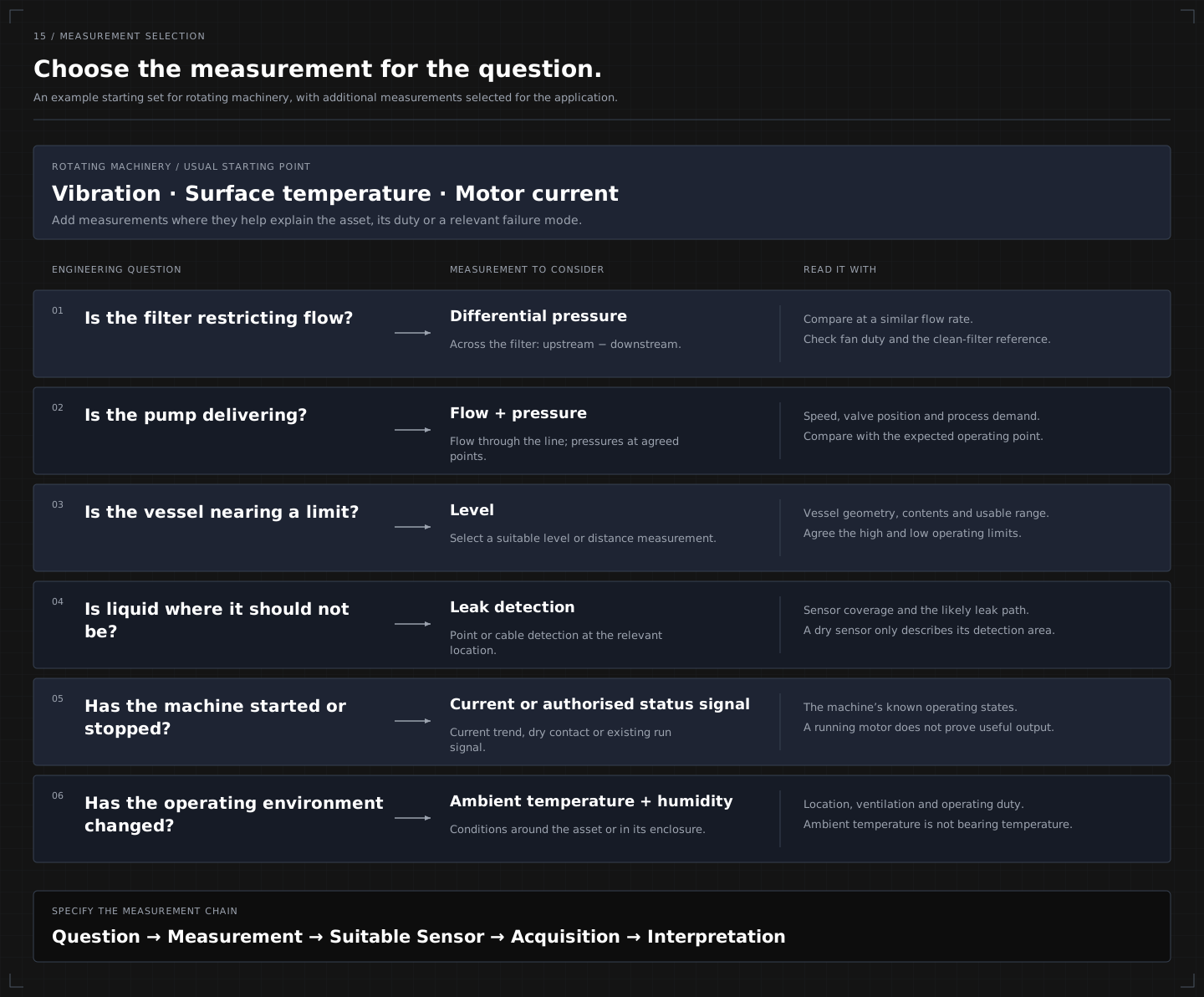
SENSOR RANGE, MOUNTING, SAMPLING, COMMUNICATIONS AND INTEGRATION ARE CONFIRMED FOR EACH APPLICATION. AWI IS HARDWARE-NEUTRAL — A DEVICE BEING AVAILABLE DOES NOT MEAN IT IS ALREADY INTEGRATED, OR SUITABLE FOR EVERY INSTALLATION. ENVIRONMENTAL NOISE IS A SITE CONDITION MEASUREMENT, NOT MACHINERY ACOUSTIC DIAGNOSIS.
Specialist techniques brought in when required.
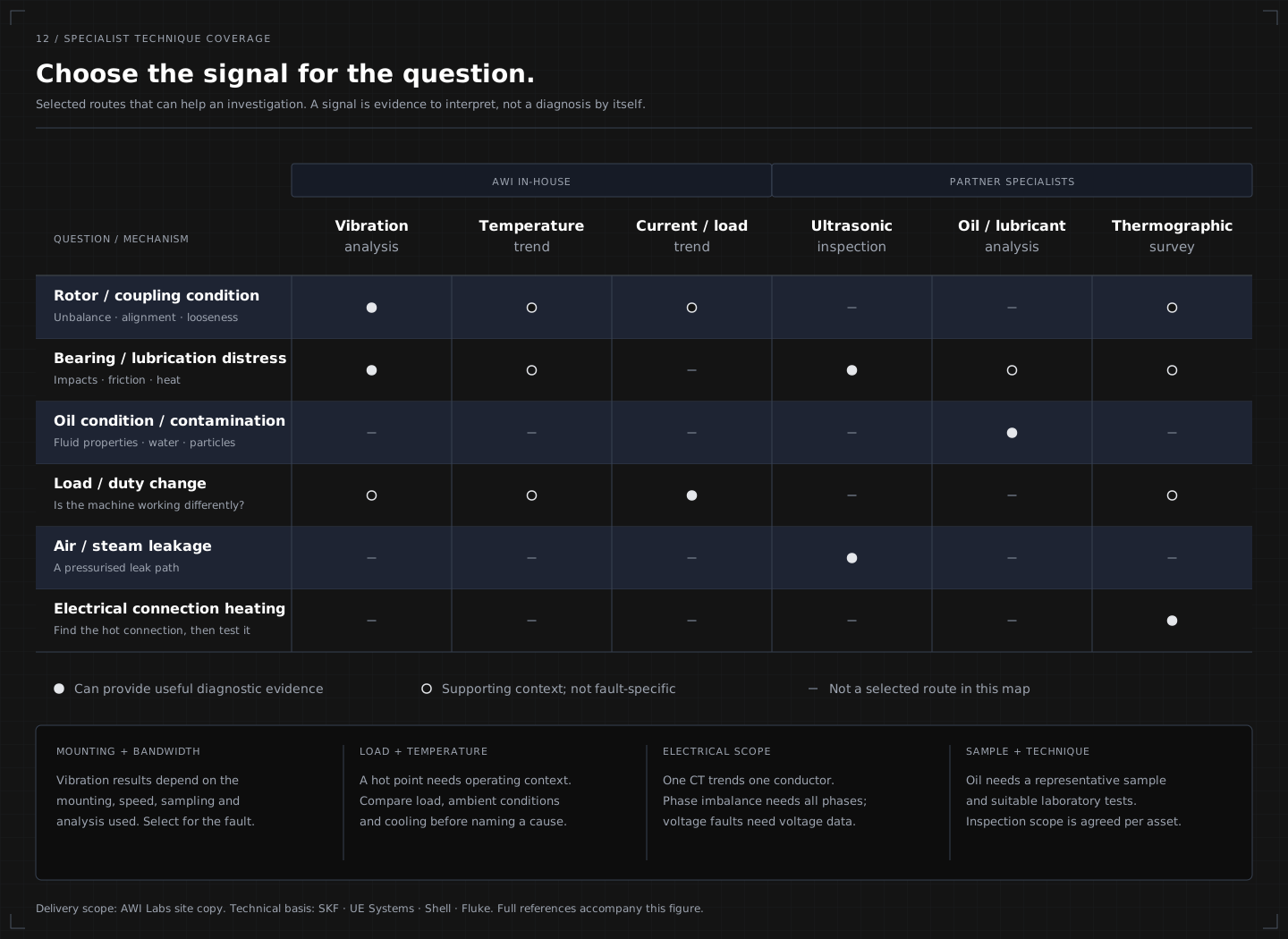
Some jobs need a technique we do not yet run in-house. Rather than leave you to find someone, we bring in a specialist we trust and brief them on what the data already shows.
Ultrasonic inspection
Listening above the audible range for compressed-air and steam leaks, passing valves and dry bearings, marked up at the machine.
Oil and lubricant analysis
Samples drawn from gearboxes and hydraulics, tested for wear metals, water, viscosity and contamination — the oil, or the machine.
Thermographic survey
A thermal camera across motors, drives, panels and steam lines to find the hot joint, blocked cooling path or loose termination.
Condition-monitoring installation and data integration.
Predictive maintenance only works if the right thing is measured, on the right asset, and joined to what you already know about it.
Condition-monitoring specification and installation
Asset survey, measurement points chosen for the failure modes that matter, sensors and gateways fitted and commissioned — vendor-neutral throughout.
Data and system integration
Live readings joined to the history in your CMMS, SCADA, historians, ERP and operator logs, so an asset has one record.
Every job is written up the same four ways.
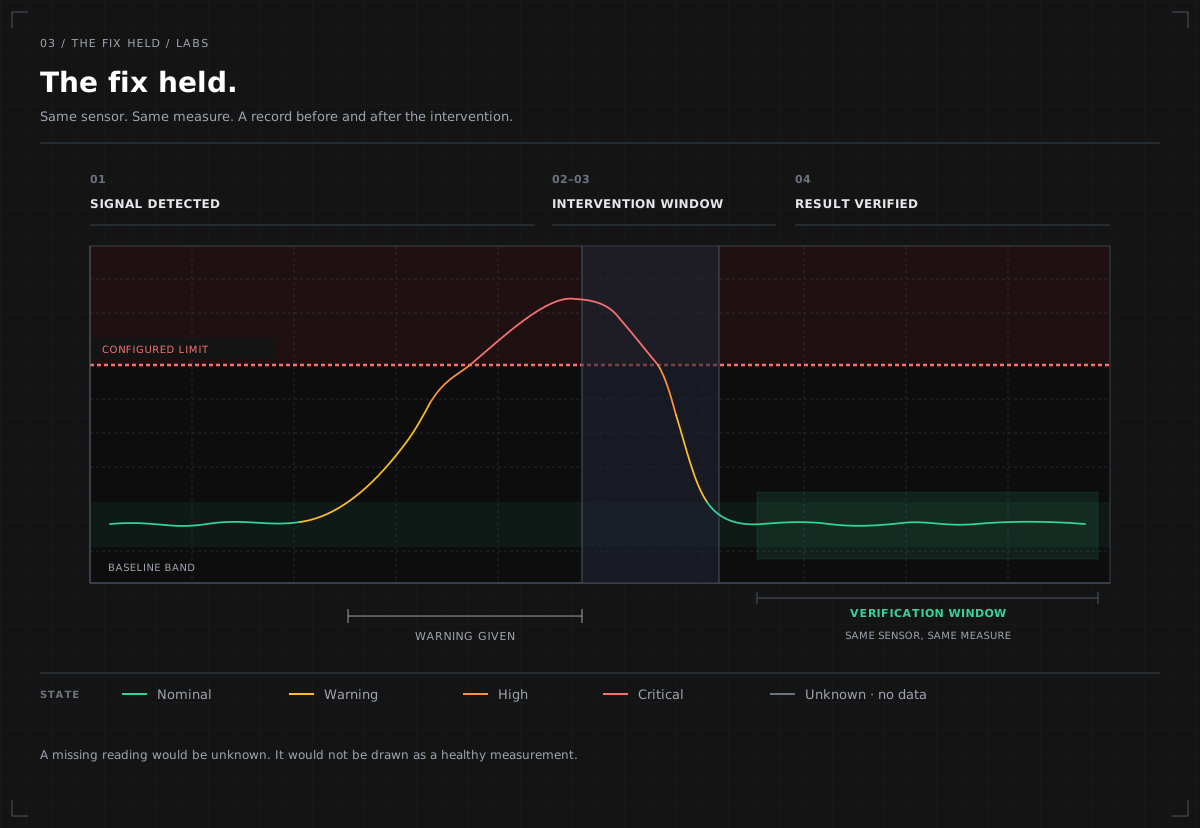
Not a case study written afterwards — a record built as the work happens, so the file for an asset shows what was seen, what was done, and what the data said next.
Signal detected
The asset, the measurement, the date, and the threshold or pattern that moved. The raw trace is kept as it was when it triggered.
Problem diagnosed
What was found at the machine, what was ruled out, and the evidence behind the conclusion — readings, images, samples, operator accounts.
Action taken
The intervention carried out, who did it, when the window was, and exactly what changed physically on the asset.
Result verified
The same measurement points read again after the work and compared with the baseline — the stage most reporting leaves out.
AWI Analytics finds and explains the opportunity. AWI Labs helps engineer the result.
The platform reads the data and says what is worth looking at. Labs goes and looks, manages the work, and measures it afterwards.
Start with one critical asset.
Tell us which machine causes you the most trouble. A 30-minute conversation is enough to work out what should be measured on it, and whether Labs is the right place to begin.